
Condition Assessment of a 22,400-Foot Industrial Process Pipeline
Case Study: Multi-Phase Corrosion Assessment Following a Suspected Pipeline Failure at a Western U.S. Industrial Operation
Project Summary
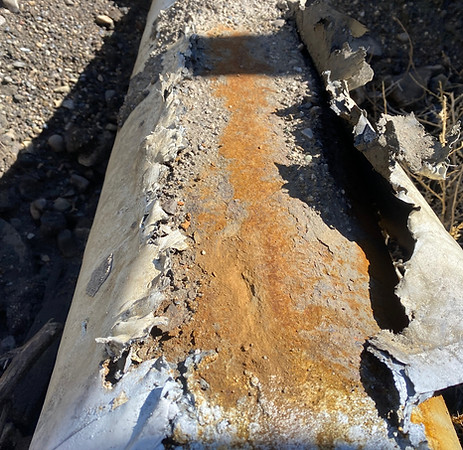
Following a suspected corrosion-related failure on a 10-inch industrial process pipeline, ICG performed a comprehensive multi-phase condition assessment to identify root causes, locate high-risk segments along the 22,400-foot alignment, and develop corrosion protection recommendations. The assessment combined soil corrosivity testing, a current-interrupted close interval potential survey, an alternating current voltage gradient (ACVG) survey, and a vault-by-vault visual inspection. The completed work has identified specific locations for direct verification and forms the basis for ICG's recommendations on cathodic protection upgrades, electrical isolation improvements, and targeted repairs.
Background
The pipeline serves an active industrial process transport operation at a major mining and metals processing facility in the western United States. The line is 10 inches in diameter, 22,400 feet long, and was originally installed with cathodic protection as the primary corrosion control strategy.
Over time, the cathodic protection program had been undermined by recurring electrical isolation issues. Isolation problems on an industrial pipeline cause cathodic protection current to flow to unintended structures rather than to the pipeline being protected, leaving sections of the pipe inadequately protected even when the rectifier appears to be operating normally. When the pipeline experienced a suspected corrosion-driven failure, the client engaged ICG to determine what was actually happening along the alignment and to develop a defensible mitigation strategy.
The questions the client needed answered were specific:
-
What were the root causes of the failure?
-
Which sections of the pipeline were at highest risk for ongoing or future external corrosion?
-
What was the soil environment doing to the pipe?
-
What corrosion protection strategies would restore reliable performance?
The Assessment Program
ICG designed a four-task program to answer these questions through a combination of independent data sources. Each task provides a different view of the pipeline's condition; combined, they provide a complete picture of where the pipeline is healthy, where it is at risk, and why.
Task 1: Soil Corrosivity Evaluation
The soil environment surrounding a buried pipeline is one of the primary drivers of external corrosion. ICG characterized the soil along the full 22,400-foot alignment through a combination of in-situ resistivity testing and laboratory analysis of soil samples.
Soil Resistivity Testing. ICG performed soil resistivity testing at approximately 1,000-foot intervals along the pipeline using the Wenner 4-pin method. Measurements were collected at 2.5-foot, 5.0-foot, 7.5-foot, and 10.0-foot depths where soil conditions allowed, with submeter GPS coordinates recorded at each location to support correlation with later survey data. Resistivity profiles at multiple depths reveal how soil corrosivity changes with depth of cover and whether shallow or deep soil conditions are driving corrosion activity on the pipeline.
Soil Sampling and Laboratory Analysis. At each resistivity test location, ICG collected soil samples using a manual soil auger and submitted them to a laboratory for analysis of:
-
pH
-
Chlorides
-
Sulfates
-
Conductivity
-
Redox potential
-
Sulfides
The combination of in-situ resistivity measurements and laboratory soil chemistry provides a complete picture of how aggressive the soil environment is at each point along the alignment, and identifies whether specific chemical conditions (low pH, high chlorides, microbially-influenced corrosion potential from sulfides) are accelerating corrosion in particular areas.
Pipeline Route Visual Assessment. During the resistivity work, the field team also conducted a visual review of the pipeline route to identify conditions that could influence corrosion activity, including:
-
Potential stray DC current sources from foreign cathodic protection systems
-
Utility crossings that could create interference or bonding issues
-
Soil types and changes along the alignment
-
Local drainage patterns that affect soil moisture and chemistry
-
Connections to existing facilities that could compromise electrical isolation
Task 3: Alternating Current Voltage Gradient Survey (ACVG)
ACVG is a non-destructive technique that applies an AC signal to the pipeline and measures the resulting voltage gradient in the surrounding soil. The magnitude and shape of those gradients reveal coating defects, holidays, and unintended electrical connections to foreign structures along the alignment.
By running ACVG immediately after the CIS, ICG produced two independent data sets that could be cross-referenced. Locations where both surveys flagged anomalies are very high confidence indicators of real coating damage or interference issues. Locations flagged by only one survey could be evaluated in context to determine whether they represented real concerns or artifacts of survey conditions. The combined data set is far more diagnostically useful than either survey would be alone, and it allows ICG to recommend specific excavation locations for direct visual verification with confidence.
Task 2: Current-Interrupted Close Interval Potential Survey (CIS)
ICG performed a current-interrupted "ON"/instant "OFF" close interval potential survey along the full 22,400-foot alignment. This is the most rigorous CIS methodology available and is the only survey approach that distinguishes IR drop from the true polarized potential on the pipeline, which is what actually matters for evaluating cathodic protection effectiveness.
The survey was conducted at 2.5-foot intervals between test stations using an Allegro field computer data logger to capture and store pipe-to-soil potential data, with submeter-accurate GPS coordinates recorded at each measurement point. Pipe locating was performed where necessary to ensure that survey measurements were collected directly above the pipeline alignment. IR drop measurements between test points were also collected, providing data on pipeline electrical continuity — a critical question given the history of isolation issues.
Task 4: Pipeline Vault Assessment
ICG conducted a visual condition assessment of each pipeline vault along the alignment. The vault inspections focused specifically on:
-
Coating performance and condition on exposed pipe sections inside vaults
-
Visible corrosion activity
-
Environmental exposures (water intrusion, chemical contamination, debris)
-
Materials of construction
-
The presence and condition of insulating flange kits
The presence and condition of insulating flange kits was a particularly important question for this project given the pipeline's history of electrical isolation issues. Insulating flange failures are one of the most common causes of CP underperformance on industrial pipelines, and a vault-by-vault inspection is often the only way to identify them definitively.

How the Data Comes Together
The strength of this kind of multi-phase assessment is that no single data source has to carry the entire diagnostic load. Each task answers a different question:
-
Soil corrosivity testing explains how aggressive the environment is at each point along the pipeline.
-
CIS data shows where cathodic protection is and isn't working.
-
ACVG data locates coating defects and foreign connections.
-
Vault inspection documents what is happening at the discrete points where the pipeline is accessible and where isolation problems most often originate.
Where two or more of these data sources point at the same location, ICG can recommend that location for direct excavation and visual verification with confidence. Where the data sources disagree, the team can reason through why, often diagnosing root causes that no single survey would have revealed. This is the kind of analysis that turns four field tasks into one engineering conclusion.
Outcome
The assessment work has been completed and ICG has identified specific high-priority locations along the alignment for direct verification and repair. The findings support a coordinated set of recommendations covering cathodic protection upgrades, electrical isolation remediation, targeted coating repair at the highest-risk locations, and follow-on monitoring to confirm that mitigation is effective.
For the client, the outcome of the work is the ability to act on the failure with confidence: knowing what caused it, knowing where the next failures are most likely to occur, and having a defensible technical record to support the capital and operations decisions that follow.
Why This Matters for Other Industrial Pipeline Operators
The approach used on this project applies to any industrial pipeline operator facing:
-
A recent corrosion-related failure with uncertain root cause
-
Recurring cathodic protection performance issues
-
A history of electrical isolation problems
-
Aging infrastructure where capital planning requires a real understanding of risk
-
Regulatory or operational pressure to document corrosion control program effectiveness
For pipelines in industrial service (slag, slurry, process water, brine, hydrocarbon, or other applications), the combination of soil corrosivity testing, current-interrupted CIS, ACVG, and structural inspection provides a defensible engineering basis for the decisions that follow. Random excavation along a 22,400-foot alignment would be prohibitively expensive and unlikely to find the worst locations. A well-designed assessment program finds them on the first try.